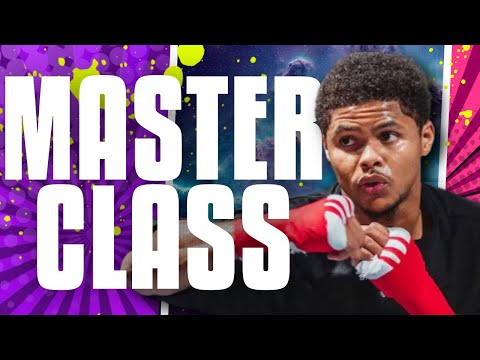
Shakur Stevenson is the most frustrating boxer today. I don't mean from the viewer's perspective. What Stevenson is a master at is defensive boxing. On the receiving end of a lot of criticism due to the lack of action in his fights. Perhaps it is justified. But the criticism of Stevenson often blinds the American's critics to what he's actually good at: defensive boxing.
Thanks for reading Shakur Stevenson film study: A defensive boxing masterclass. If you want to receive this directly to your inbox, please sign up below!
Shakur Stevenson: Hard to hit
Boxing is about hitting and not getting hit. While Stevenson gets his fair share of criticism on hitting, defensively he is second to none in the sport. Making himself hard to hit is what makes Stevenson such a talented fighter. He starts with a fairly basic approach: hand fighting.

Andre Ward hand fighting
There's no one better at hand fighting than Andre Ward. But Shakur Stevenson is a student of the game and likely looked at he, Floyd Mayweather and others to develop his defensive approach.
Against Harutyunyan, Stevenson made sure to keep his hand on top of his opponent. Pinning the glove to Hautyunyan's lead hand made it harder for Harutyunyan to jab, which is the start of most combinations. Without a lead hand, Harutyunyan is forced to either move his lead hand, which Shakur Stevenson feels and can react too, or lead with his power hand, which Stevenson is watching because the lead hand is pinned.
Knowing the jab is the basis of a good offensive attack, taking away the jab is the best way of stifling said offensive attack.
Stifling the opponent's jab with the lead hand is not the only way Shakur Stevenson makes himself hard to hit. He utilizes cross checks, forearm deflections, and the shoulder roll to make trying to hit him the most frustrating part of fighting him.
Checking with both hands comes naturally to Shakur Stevenson. When Harutyunyan pressed, (1) Stevenson stifled the lead hand by placing his on top, blocking it's straight path. As Harutyunyan throws the right cross, (2) Stevenson catches it with his left hand and employs the long guard to further make the path of a follow up punch difficult. Finally, (3) Stevenson reaches out again to touch the lead hand of Harutyunyan.
In combination with the hand checks, Stevenson will use his forearms, cross checking and more to further frustrate his foe.
Once again, (1) Harutyunyan is in the attack with a left. As you can see, Stevenson raises his forearm, blocking the punch. Expecting a follow up, (2) Stevenson returns to the high guard and, as predicted, Harutyunyan throws a left. Harutyunyan (3) makes a great choice next and throws the left to the body. Stevenson had a high guard and left the body exposed.
But Stevenson would learn from this almost instantly.
(4) Harutyunyan continues his combination with a straight left that Stevenson blocks with his glove. Making his adjustment from two punches ago, (5) Stevenson will predict the left to the body, the exact punch Harutyunyan landed earlier, allowing it to land harmlessly on the back. Not to be deterred, Harutyunyan (6) ends his combination with a right that Stevenson deflects with his arm again.
X This is what makes Shakur Stevenson so frustrating to fight. Harutyunyan threw six punches of which one landed, that left to the body. Furthermore, Stevenson made an immediate adjustment on the exact same punch less than a second later, showing Harutyunyan that there will be no free shots.
Utilizing the shoulder roll
That turn into the punch of Artem Harutyunyan is nothing new for Shakur Stevenson.
Like Floyd Mayweather before him, Shakur Stevenson is incredible at utilizing the shoulder roll. Again, boxing is about hitting and not getting hit. While Stevenson is not quite known for hitting, he's a master at not getting hit.
To those unfamiliar with the shoulder roll, often called the "Philly Shell," is a defensive position that aims to lower a fighter's profile and deflect punches with a multitude of different techniques.
Going from top to bottom, the shoulder is a huge part of the shoulder roll and where the defensive system gets it's name from. When a cross is thrown, the defending fighter gets behind the shoulder and rolls with the punch. The rear hand is to defend against the lead hook and used to cross guard, as we've seen with Stevenson previously. The lead hand is low, substituted by the shoulder, and protects the body by laying across the mid section.
Attacking the shoulder roll is not impossible by any means, but a boxer who doesn't think critically about an approach will be left missing the majority of his or her punches.
Let's focus in on the shoulder first. The best way to defend the lead side of your chin is to put a giant chunk of bone and muscle between it and the punch. (1) First we see UFC featherweight champion Ilia Topuria guarding the left hook with his right hand high and tucking his chin behind his shoulder. (2) As his opponent throws the right hook, something he is known for, Topuria rolls with the punch and it glances off his shoulder.
Building on the shoulder roll, Stevenson will stand right there in the pocket, right in front of Harutyunyan, and force his opponent to throw and make him miss.
Stevenson loves to dip under a right hook off of the shoulder roll. He will often shove his opponents out of the pocket and not take a single blow doing so. This is something Teofimo Lopez, an orthodox fighter, does to southpaws like Vasyl Lomachenko and Josh Taylor.
Taking a closer look at Teofimo Lopez, the bigger Josh Taylor wanted to smother Lopez, lean on him, and tip the gas tank disparity in his direction. Lopez had an answer…
Taylor (1) stepped into Lopez, but as the distance was closed, (2) Lopez managed to get his arm in between he and Taylor. Lopez then simply (3) pushes off of Taylor, denying him the clinch.
Hitting and not getting hit
Now to win a boxing match, Shakur Stevenson has to hit, despite seemingly not wanting to. While sparse, Stevenson's offense is well thought out.
Hooking off the jab and, as animated above, jabbing off the hook are effective tools used by Stevenson. With his hand fighting, the hook coming off of a pseudo-jab is something he likes to employ.
(1) Stevenson will often plaster his glove to his opponents, taking away their jab. He pulls down their lead hand, (2) retracts his hand, and (3) lands the hook home.
Stevenson often pulls down the lead hand of his foe to create a punching lane. It's this type of deception that works well with Stevenson's defensive style. But there are some things Stevenson could add to his arsenal that would make his striking that much more dangerous and frustrating.
Of course, there's the 1-1-2. Stevenson will double up on the double jab, and like against Harutyunyan, when he's wanting to get a finish, he will often go for the left cross. But the lack of work and output from Stevenson over the course of a fight hurts the amount of damage he puts out.
Another thing that could be added to Shakur Stevenson's game is a pull counter cross. Made famous by Floyd Mayweather in recent decades, this would work hand in hand with his shoulder roll.
To see how this and other combination punches can work off of the shoulder roll, we go back to Ilia Topuria. (1) Topuria starts by jabbing in and pivoting around (2) to anticipate his opponent's booming right. (3) Topuria shoulder rolls with the right hand, glancing on his shoulder. You can see the right hand cocked and ready to go. (4) Topuria fires home the right hand up the middle and follows up with a (5) lead hook and (6) rear hook.
Shakur Stevenson is incredibly frustrating to fight and to watch. While he can improve, he's certainly one of the best in boxing today, regardless of the lack of his offensive output. Fighters like Gervonta Davis and Vasyl Lomachenko are fan favorites because of their offense spectacles. But Stevenson is a sleeper to show up to these fighters front doors and make them look mortal.




No comments:
Post a Comment